

Costco scores 77.3. ChatGPT scores 69.6. Wells Fargo scores 58.2. Three numbers, all on a 0–100 scale. But on their own, they don't tell you much.
A reputation score only makes sense once you know two things: what it's built from, and how the brand compares to others. That's the gap most reporting misses. A score moves two points, and someone calls it good news – or bad news – without asking what actually changed.
This guide walks you through how HarrisQuest scores reputation, what the score tiers mean, and why two brands can share the same overall number and tell very different stories.
What a reputation score actually measures
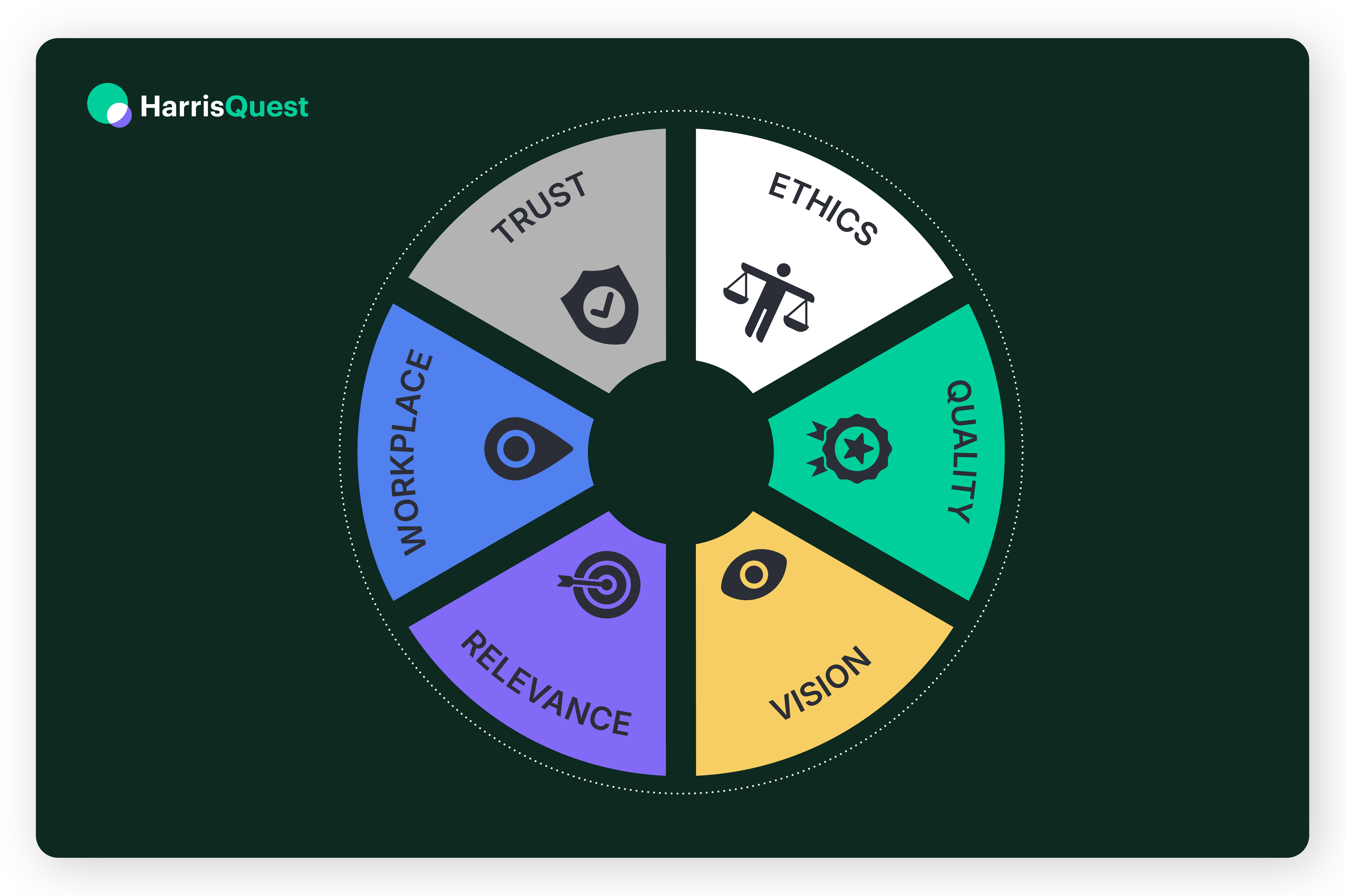
A reputation score – or QRQ (Reputation Quotient) – combines six dimensions of trust into one composite figure, scored 0 to 100.
Those six dimensions are:
- Trust – do you trust this company?
- Ethics – does it hold high ethical standards?
- Quality – how good are its products and services?
- Vision – does it have a clear direction?
- Relevance – does it shape today's conversations?
- Workplace – does it look like a good place to work?
Respondents rate each dimension on a 1–7 scale. Those six scores combine into the final composite. QuestRQ, the reputation module inside the HarrisQuest platform, builds on 28 years of Reputation Quotient research from The Harris Poll.
Each dimension carries different weight. Trust anchors the whole score: it's the strongest predictor of Quality, driving roughly 30.8% of how people rate a brand's products and services. Ethics sets the ceiling. No brand scores above 75 unless its Ethics rating tops 71.
The five tiers, and what separates them
Once you have the composite score, it lands in one of five tiers. These bands aren't arbitrary. They mark where real, structural protection shows up in the data.
- Critical (below 45) – structural damage that needs leadership to step in. Example: Snapchat among Boomers, 43.5.
- Weak (45–54) – structural vulnerability that takes years to repair. Example: Spirit Airlines, 52.1.
- Average (55–64) – where most brands sit. Example: Wells Fargo, 58.2.
- Strong (65–74) – a real commercial edge, where investment pays off. Example: ChatGPT, 69.6.
- Resilient (75+) – pricing power, room to grow, and faster recovery from a crisis. Example: Costco, 77.3.
The gap between Strong and Resilient matters more than it looks. Below 75, a brand still feels every bad news cycle. Above it, reputation starts working as a buffer instead of a risk.
Why 75 is the number that matters most
Most reputation trackers treat their scale as smooth: higher is simply better. Our data tells a different story.
Something shifts once a brand crosses 75. It gains what we call resilience: room to make mistakes, room to raise prices, and room to recover faster after a setback. Below that line, every dip in the news cycle chips away at the score. Above it, the score absorbs the hit.
That threshold isn't a design choice – it's a pattern we see across the more than 570 brands we track in QuestRQ. Ethics acts as the gate. A brand can be well-liked and well-known, and still miss 75 if its Ethics score sits below 71.
One national score can hide a generational split
A single national reputation score can flatten a real split underneath it.
Take Mayo Clinic. It ranks third in the country on QRQ – a headline number that looks resilient. But break it down by generation, and the picture changes fast. Boomers rate it 84.8, solidly Resilient. Gen Z rates it 63.3, only Average.
Healthcare brands often assume trust carries across generations. This split shows it doesn't always hold. A national average can hide exactly the audience a brand most needs to understand – whether that's the generation it's losing, or the one it hasn't won yet.
The same lesson applies beyond healthcare. Whenever a reputation score looks stable, ask which segments are propping it up – and which ones aren't.
How we score reputation, and who gets counted
Not every brand that wants a reputation score gets one. Selectivity is part of the method, not a side effect.
To qualify for the full QuestRQ battery in the US, a brand needs to clear a 47.5% familiarity threshold among respondents. Below that line, too few people recognize the brand – and the ones who do skew toward fans. That makes the sample meaningless.
About one in three submitted brands fail that gate at intake. Submitting a brand doesn't guarantee it a score. We also typically exclude sub-brands and product variants: Tide qualifies, Tide Pods doesn't.
That gate protects the number. When familiarity runs thin, the respondents who do recognize a brand tend to rate it favorably – so the score ends up reflecting them, not the country. The 570-plus brands that clear the bar get measured against the same consistent standard, every day.
Read your own number the same way
A reputation score starts a conversation – it doesn't end one. The tier shows you where a brand stands today. The six dimensions underneath show you why, and which lever actually moves it.
If Ethics caps the composite, that's a governance conversation for your CEO and board. If Relevance lags, that's a marketing problem, not a trust problem. The number alone won't tell you which one you're facing. The dimensions will.
Request your brand's QRQ score to see where you stand across all six dimensions, benchmarked against the full HarrisQuest field.