

Last week, the company that makes Claude asked the rest of the AI industry to slow down. Anthropic called for a coordinated pause on the most advanced systems, warning that the technology is improving faster than anyone can make it safe. When a leading lab says its own field is moving too fast to control, the question worth asking is what everyone outside the labs makes of it.
We took up that question last summer, when we asked whether the hottest AI could outlast its hype. The worry then was momentum: ChatGPT’s awareness had gone vertical, and brands that climb that fast usually slide once the novelty wears off. The data now has an answer, and momentum was the wrong thing to watch. Attention did everything it was meant to do – it climbed, it peaked, it reached nearly everyone. What never came with it was trust.
The reach is settled. ChatGPT now has nine hundred million weekly users, by OpenAI’s count, close to one in ten adults on earth, fielding some two and a half billion messages a day. Showing up was never the question.
HarrisQuest scores every major brand in America on two things that move independently. Relevance is cultural pull – how current a brand feels, how much it looks like it’s shaping what comes next. Trust is credibility – the belief that a brand does right by the people who use it.
Top of the culture, bottom on trust
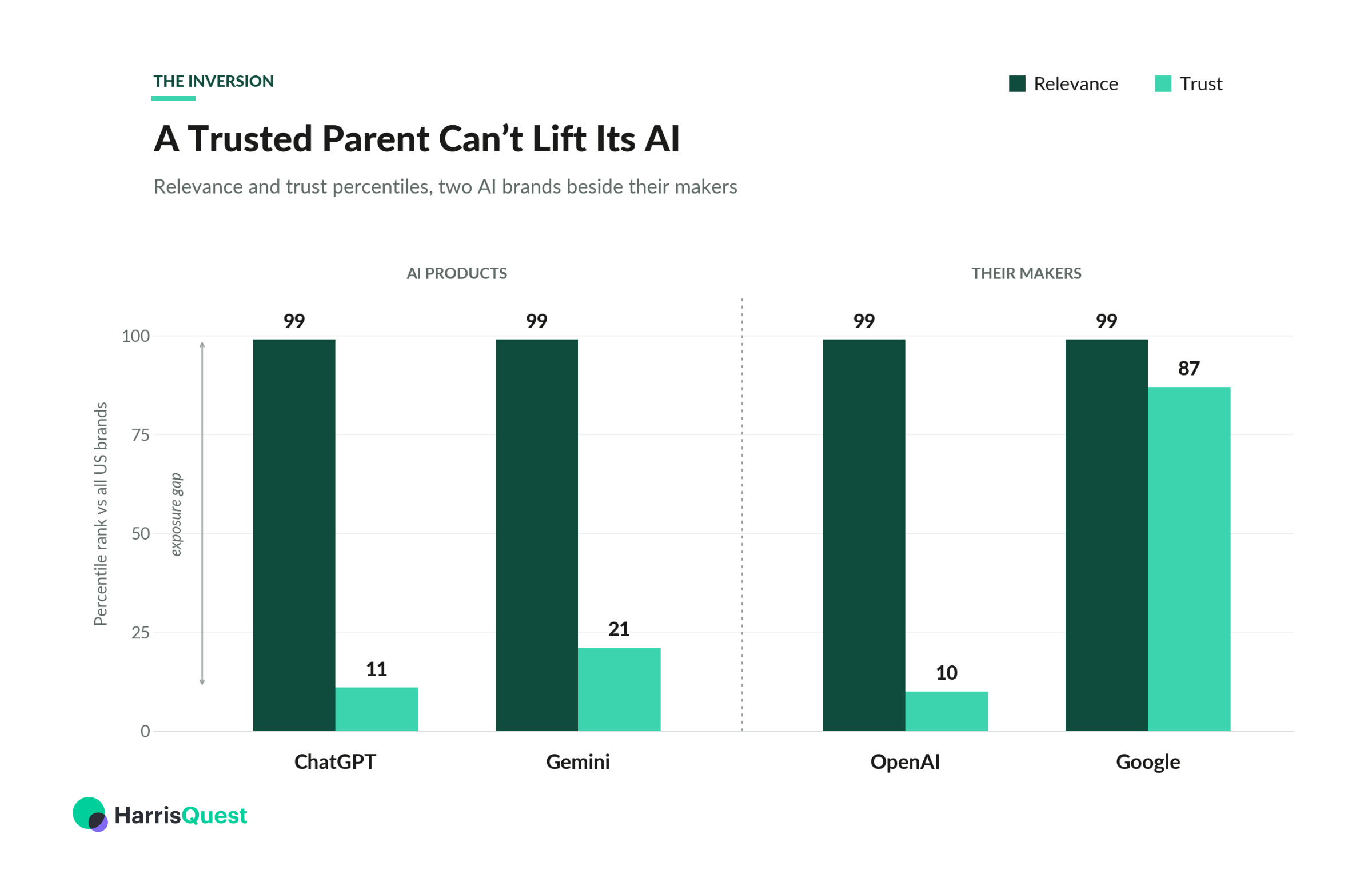
On relevance, AI’s biggest names rank in the top one percent of everything HarrisQuest measures. On trust, they sit near the bottom. The gap is not subtle. ChatGPT ranks in the 99th percentile on relevance and the 11th on trust; Gemini, its nearest rival, sits at the 99th and the 21st. America has let AI all the way in without deciding to believe it.
The companies behind them split. OpenAI, which makes ChatGPT and makes nothing else, carries the same inversion as its product: the 99th percentile on relevance, the 10th on trust. Google breaks the pattern. The parent of Gemini ranks just as high on relevance and, alone among these names, high on trust as well – the 87th percentile, built over decades into one of the most trusted brands in the country.
And none of that reaches Gemini. A company the public has trusted that long cannot lend that trust to its AI.
Relevance doesn’t buy trust
It would be natural to assume relevance and trust travel together, that a brand on everyone’s lips is one people believe in. Across the brands HarrisQuest measures, they barely relate. Plot all of them, relevance against trust, and the cloud is close to shapeless: the correlation is 0.18. Relevance and trust are different engines, and a brand can run hot on one while the other stays cold. The AI names are the clearest case in the data, parked in the far corner: maximum relevance against middling trust. It is what HarrisQuest calls an exposure gap, cultural presence arriving well ahead of the credibility to carry it.
.png)
The peak is the arrival
ChatGPT’s net momentum climbed for two years, peaked near 38 in the autumn of 2025, then turned down – even as awareness kept rising past ninety percent of the country. That divergence is the tell.
Momentum counts how many people see a brand as still on the way up, and once a brand reaches nearly everyone, almost no one is left to watch it rise. The peak is the moment of saturation: ChatGPT has arrived in full, its climb behind it. Even the GPT–5 launch, which looked at the time like it might bruise the brand, only fed that climb – a product release moves attention and leaves trust where it sits. Arrival is supposed to be when a brand’s standing settles. For ChatGPT, nothing did.
.png)
The trust never came
If ChatGPT’s standing were settling anywhere, it would be in trust. It isn’t. Awareness is near–universal now, but hearing of a brand and trusting it are different things, asked of different people: trust runs only among those familiar enough to have a view. Among them, ChatGPT’s trust has held in the low 60s since QuestRQ began tracking it in late 2025, near the floor while relevance holds near the ceiling – no climb, and in the most recent weeks a drift lower. More people meet it every week, and belief never follows.
Familiarity didn’t breed trust
The sharpest version runs backward from the easy assumption. Gen Z is the most familiar with AI of any age group, at eighty–five percent, and it trusts ChatGPT the least, several points below its elders. The thing that was supposed to breed comfort has done the opposite among the people closest to it. Millennials, nearly as familiar, trust it most; the skepticism concentrates in the youngest, most native users. Some of it is Gen Z’s broader wariness of institutions, which extends well beyond technology. But the direction holds: a year of deeper use, and not a point of trust to show for it.
.png)
Why trust lagged
The data can’t say why trust has lagged this far behind use; that part is interpretation. The plainest reading is that adoption outran track record. People reached for these tools years before anyone could answer the questions underneath them: what happens to the data, who answers when the output is wrong. Trust comes the slow way. A brand earns it by being the same brand year after year – getting the ordinary things right until people stop bracing for the exception. The brands people trust are the ones that kept showing up, and no amount of reach buys that. AI has the reach. What it does not have yet is the years.
The deficit is not the same for every brand. The newer names – Claude and its maker Anthropic, along with Perplexity – show the same inversion in a milder form: slightly less relevant than the giants and, among the few who know them, more trusted. Too few Americans know them to rank, and the few who do are mostly users. Users trust what they use, so read the edge lightly: it tends to thin as a brand grows. Grok is the exception, and a telling one. The same tailwind should flatter it, and instead the people who know Grok place its trust near the floor of everything HarrisQuest measures – a trust score that would rank in the 4th percentile, against relevance in the 89th.
The likeliest reason sits next door. X, the platform Grok lives inside, carries nearly the lowest trust score in the entire field, below Spirit Airlines, and Tesla sits a few points above it: three brands, one owner, all parked at the bottom on trust while holding their relevance. Distrust can attach to a technology, as it has with AI. It can also attach to a person. And X is the reminder that time alone does not repair it – nearly two decades, most of them as Twitter, and the trust never came, because showing up badly compounds the same way showing up well does. What holds across all of them is that trust is specific. It belongs to the brand and to whoever stands behind it, and it is earned or missed one company at a time.
Relevance is quick, trust is slow
Relevance is the half that arrives quickly, with a launch, a demo, a season of being everywhere at once, and AI has had all three. Trust is the half that takes time, and the absence of the failures that teach people to hesitate. A relevance score tells you a brand has the country’s attention. A trust score tells you whether it has the country’s confidence. For AI right now, the attention is near total and the confidence has barely begun. The window to close that distance stays open while a category is still new and forgiving, and it is starting to shut. The brands that matter a decade from now are the ones building trust while it is still open.
Source: The Harris Poll and HarrisQuest. Reputation scores and percentile ranks: QuestRQ, US National, cumulative December 2025 through May 2026, among adults familiar with each brand; ranked brands meet a 47.5% familiarity threshold and a minimum sample of 100; relevance and trust are mean scores on a 0–to–100 scale, not shares of respondents. Momentum and awareness: QuestBrand, US National, twelve–week moving average, July 2023 through May 2026. Generational figures: QuestRQ and QuestBrand, Q1 2026. Usage figures are OpenAI’s reported counts. Claude, Anthropic, Perplexity, and Grok fall below the familiarity threshold to rank and are reported as directional; Grok’s reputation read is based on 257 familiar adults.
HarrisQuest is The Harris Poll’s brand and reputation intelligence platform, measuring how the public sees about 1,600 brands every day.